
Mon - Sat : 9am to 7pm Sunday is CLOSED


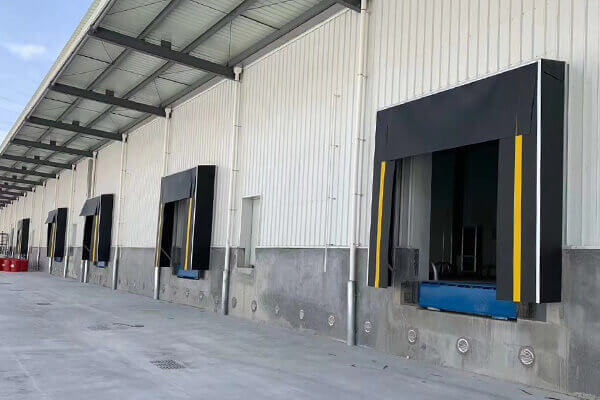
The loading dock is the most critical bottleneck in the supply chain. It is the key node where internal logistics and external transportation converge. In today’s hybrid fleet environment, the efficiency of this process directly determines the throughput of your facility. When designing or upgrading facilities, warehouse managers often face a fundamental infrastructure challenge:Dock Lift or Dock Leveler?
While they serve the same ultimate goal—bridging the gap between the warehouse floor and the transport vehicle—they approach the problem with entirely different mechanics and operational philosophies. Choosing the wrong equipment isn’t just a minor inconvenience. It can lead to capped operational capabilities, safety hazards for forklift operators, and costly bottlenecks that ripple through your entire distribution schedule.
In this guide, we provide a technical and operational comparison of these two systems – Loading Dock Lift vs Dock Leveler. We will dissect their vertical capabilities, load capacities, and cycle times to help you determine which solution—is required to optimize your loading dock operations for safety and efficiency.
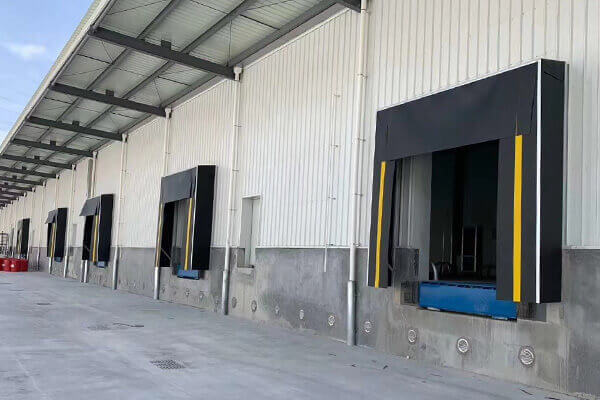
Contents
Basic Concepts of a Loading Dock System
In modern logistics, warehousing, and manufacturing facilities, the loading dock system serves as the critical interface between transportation vehicles and internal material handling operations. A well-designed loading dock system directly impacts loading efficiency, workplace safety, and operational costs.
Definition and Components of a Loading Dock
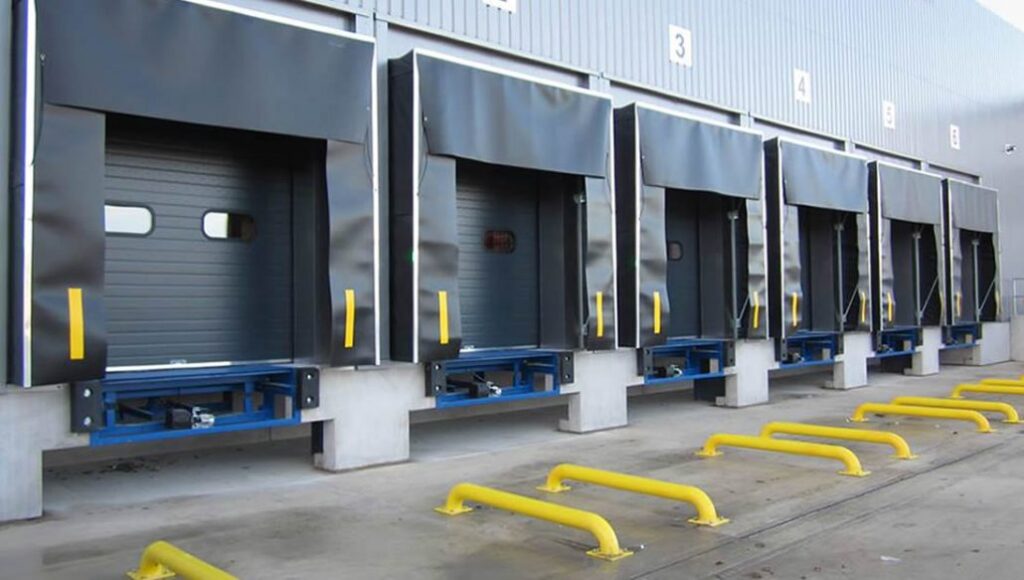
A loading dock is a designated area of a warehouse, distribution center, or industrial facility where goods are loaded onto or unloaded from trucks. It is typically located along the exterior wall of a building and designed to align warehouse floor height with vehicle cargo beds.
From a functional perspective, a loading dock enables:
- Efficient transfer of goods between trucks and warehouse floors
- Safe operation of forklifts and pallet handling equipment
- Controlled access to the building interior
A standard loading dock is composed of several essential components, including:
- Dock Bumpers – Absorb impact and protect the building structure during truck docking
- Vehicle Restraints – Secure trucks in position to prevent unintended movement during loading and unloading
- Dock Seals or Dock Shelters – Close the gap between the truck and the building to improve weather protection, hygiene control, and energy efficiency
- Loading Dock Doors – Control access to the loading dock opening while enhancing safety, insulation, and environmental separation
These components work together to form a complete and reliable loading dock system.
Two Core Hydraulic Dock Levelers in Loading Dock Systems
Within a loading dock system, hydraulic platforms play a critical role in addressing height differences and ensuring smooth cargo transfer. The two most important hydraulic solutions are Dock Levelers and Dock Lifts, each serving a distinct operational purpose.
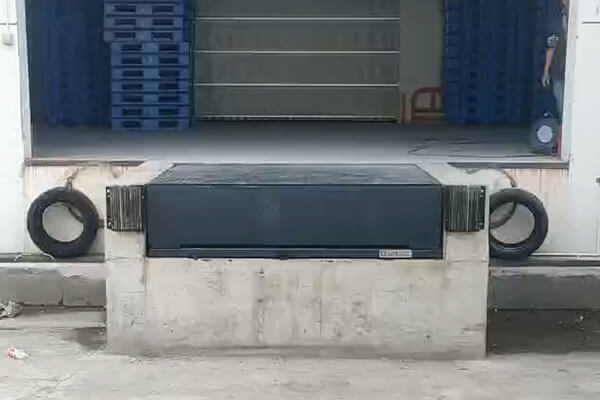
Warehouse Pit Dock Leveler
A warehouse dock leveler is a hydraulic or mechanical platform installed at the edge of a loading dock. Its primary function is to bridge the height difference between the warehouse dock and the truck bed, creating a smooth and stable path for forklifts and pallet trucks.
Key characteristics include:
- Designed for use with fixed loading docks
- Ideal for standardized truck heights
- Optimized for high-frequency loading and unloading operations
Dock levelers are considered a core component of traditional loading dock systems in logistics centers and distribution hubs.
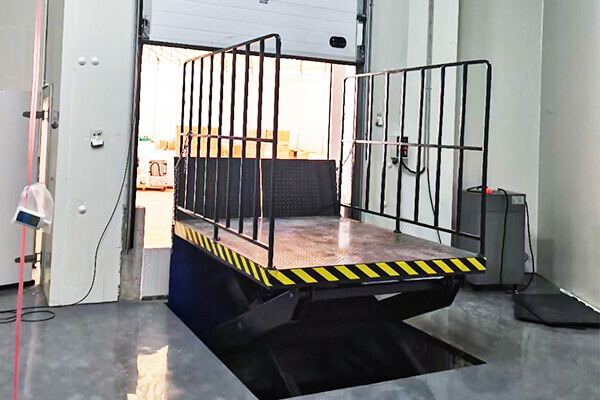
Laoding Scissor Dock Lift
This is a hydraulic-driven vertical lifting device that is engineered to transfer items straight up and down between various elevations. It is different from dock levelers in that it does not depend on a fixed loading bay height. It is also designed for use in loading and unloading activities from the ground to higher level walkout platforms.
Key characteristics include:
- Accommodates a wide range of truck heights
- Suitable for facilities without standard loading docks
- Can function as both a loading platform and a vertical lifting solution
In modern loading dock design, dock lifts are often used to increase flexibility in facilities handling mixed vehicle types or non-standard loading conditions.
Comparative Analysis: Dock Lift vs. Dock Leveler
Functional Differences
- Loading Dock Leveler: A device for seamless transition between warehouse loading bays and truck beds. It compensates for minor height discrepancies caused by truck type or load, enabling efficient forklift access to vehicles.
- Loading Dock Scissor Lift: A loading dock lift platform unit that adjusts load height to match vehicle levels. Ideal for scenarios with large height differences (e.g., trucks, vans, containers) or where no fixed loading bay exists.
Loading Dock Lift vs Dock Leveler: Side-by-Side Comparison
| Comparison Factor | Dock Leveler | Dock Lift |
|---|---|---|
| Primary Function | Bridges the height gap between dock and truck | Vertically raises or lowers loads |
| Movement Type | Angular or limited vertical adjustment | Full vertical lifting motion |
| Installation Requirement | Requires a fixed loading dock | Can be used with or without a dock |
| Typical Height Range | Small height compensation | Wide vertical travel range |
| Vehicle Compatibility | Best for standard truck heights | Suitable for mixed vehicle types |
| Ground-Level Loading | Not suitable | Fully supported |
| Loading Frequency | Ideal for high-cycle operations | Moderate to flexible usage |
| System Role | Core component of traditional docks | Flexible or supplemental solution |
| Space Requirement | Integrated into dock pit | Requires dedicated platform space |
Application Scenarios and Use Cases
Warehouse dock levelers are most commonly used in:
- High-volume logistics centers
- Distribution warehouses with uniform truck fleets
- Facilities prioritizing fast turnaround times
Loading dock scissor lifts are typically selected for:
- Buildings without traditional loading docks
- Mixed fleets including vans, box trucks, and trailers
- Operations requiring both loading and vertical material transfer
Frequently Asked Questions (FAQ): Dock Lift vs. Dock Leveler
1. What is the main difference between a dock lift and a dock leveler?
The main difference lies in function and vertical movement.
A dock leveler bridges the height gap between a fixed loading dock and a truck bed, while a dock lift vertically raises or lowers loads between ground level and truck height. Dock levelers are ideal for standard docks, whereas dock lifts offer greater flexibility for non-standard or ground-level loading.
2. When should I choose a dock lift instead of a dock leveler?
A dock lift is the better choice when:
- There is no fixed loading dock
- Trucks or vehicles have varying bed heights
- Ground-level loading is required
- The facility needs vertical lifting capability in addition to loading
Dock lifts are commonly used in facilities with space constraints or mixed vehicle fleets.
3. Which option is faster for high-volume loading operations?
A dock leveler is generally faster for high-volume operations.
Once deployed, it allows continuous forklift traffic without repeated adjustments. Dock lifts require raising and lowering for each load cycle, making them slower in high-frequency loading environments.
 Spanish (Argentina)
  English
  Arabic
  Spanish (Mexico)
  French
  Russian
  Uzbek
Uzbek  Japanese
  Korean
  Indonesian
  Spanish (Peru)
  Spanish (Venezuela)
  Spanish (Costa Rica)
  Spanish (Ecuador)