
Mon - Sat : 9am to 7pm Sunday is CLOSED


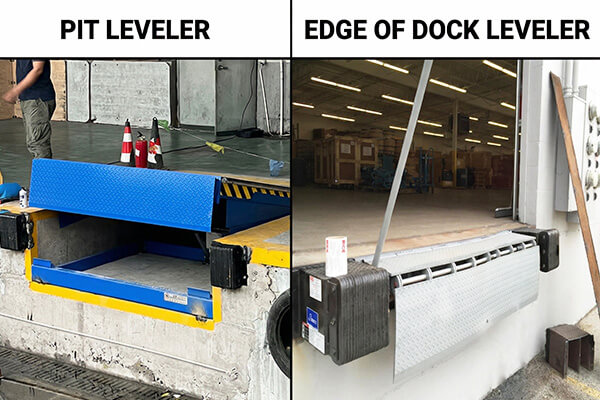
In the high-stakes world of modern supply chains, the loading dock is the critical heartbeat of your operational efficiency. Choosing the right loading dock equipment is the definitive factor in ensuring a seamless transition from warehouse floor to trailer bed. However, for many facility managers, the debate often boils down to two industry stalwarts: the Pit Levelers and Edge of Dock Levelers.
-
- Pit Levelers are the heavy-duty powerhouses, integrated directly into a recessed concrete pit to handle diverse trailer heights and high-volume traffic.
-
- Edge of Dock Levelers offer a streamlined, surface-mounted alternative—ideal for facilities seeking a cost-effective, space-saving solution without major structural alterations.
But which one truly aligns with your specific throughput demands and long-term ROI? In this guide, we break down the critical engineering differences, installation requirements, and performance benchmarks to help you optimize your loading bay.
目录
- 1 Pit-Style Hydraulic Dock Levelers — The Industrial Workhorse
- 2 Edge of Dock Levelers — The Agile Efficiency Expert
- 3 Pit Levelers vs. Edge of Dock Levelers: Strategic Comparison
- 4 2026 Selection Guide: Choosing the Right Warehouse Dock Leveler for Your Facility
- 5 In Summary
- 6 常见问题解答
Pit-Style Hydraulic Dock Levelers — The Industrial Workhorse
Engineering and Structural Integration
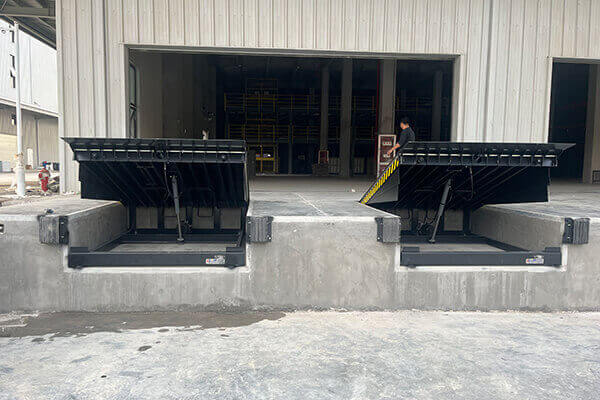
Unlike surface-mounted alternatives, a Pit Leveler is installed into a pre-formed concrete pit within the warehouse floor. When not in use, the leveler sits flush with the surrounding floor surface, creating a seamless, unobstructed path for cross-docking traffic. This integration allows for a much longer ramp, which is critical for managing significant height variances.
Key Advantages of Pit-Style Dock Levelers
For facilities prioritizing long-term operational efficiency and safety, the Pit Leveler offers several unmatched benefits:
Exceptional Operating Range
Most standard pit loading dock levelers provide a working range of 12 inches (30cm) above and below the dock height. This flexibility ensures your facility can accommodate a diverse fleet of vehicles, from standard semi-trailers to low-profile refrigerated trucks.
Smoother Transitions & Forklift Longevity
Due to its longer deck length, the Pit Leveler creates a much shallower grade (lower slope). This minimizes the “bump” experienced by forklift drivers, significantly reducing tire wear, suspension damage, and the risk of cargo shifting or damage during transit.
Superior Load Capacity
Built for the toughest environments, these units can support massive dynamic loads—often rated for up to 15 tons or more. They are the ideal choice for heavy-duty electric forklifts and high-frequency loading cycles.
Limitations and Considerations
Higher Initial Investment
The total cost of ownership (TCO) at the start is higher than simpler models. This includes not only the unit itself but also the civil engineering costs associated with concrete pit excavation and specialized installation.
Maintenance & Hygiene Requirements
Because they are recessed, the “pit” can act as a collection point for dust, debris, and shrink wrap. To prevent mechanical failure and ensure compliance with safety standards, regular cleaning and hydraulic inspections are necessary to keep the system running at peak performance.
Edge of Dock Levelers — The Agile Efficiency Expert
Engineering and Structural Simplicity
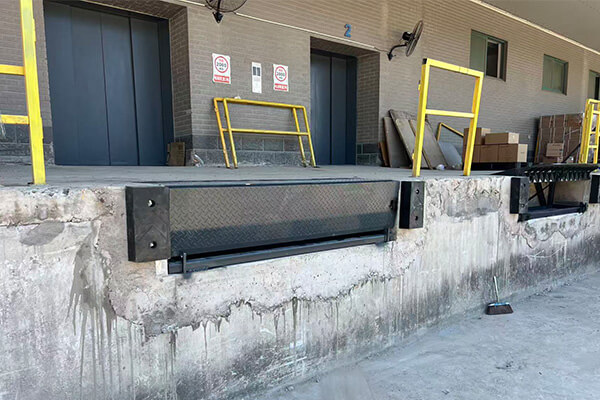
The Edge of Dock Leveler is its mounting method. Unlike recessed systems, the edge leveler is surface-mounted directly to the face of the loading dock. It acts as a bridge that can be mechanically or hydraulically activated to rest on the trailer bed. Because it sits on the exterior edge, it eliminates the need for complex internal floor modifications.
| Specification Category | Mechanical 卸货平台边缘 | Hydraulic 卸货平台边缘 |
| Operation Type | Manual (Lever/Pull-chain) | Push-button (Electric Control) |
| Actuation Method | Balanced Gas Spring / Torsion Spring | Single/Dual Hydraulic Cylinder |
| Standard Capacity (CIR) | 20,000 / 30,000 / 35,000 lbs | 20,000 / 30,000 / 35,000 lbs |
| Material Strength | 55,000 PSI Min. Yield Steel | 55,000 PSI Min. Yield Steel |
| Platform Widths | 66″ / 72″ / 78″ / 84″ | 66″ / 72″ / 78″ / 84″ |
| Lip Length (Standard) | 15″ (381mm) | 15″ (381mm) |
| Service Range | $\pm$5 inches (127mm) | $\pm$5 inches (127mm) |
| Lip/Deck Thickness | 3/8″ to 1/2″ (Capacity dependent) | 3/8″ to 1/2″ (Capacity dependent) |
| Electrical Req. | N/A (Self-contained) | 115V-230V (1PH) / 208V-460V (3PH) |
| Motor Output | N/A | 1.25 HP TENV Motor (Standard) |
| Mounting Style | Surface / Face Mounted | Surface / Face Mounted |
| Standard Compliance | ANSI MH30.1-2022 | ANSI MH30.1-2022 |
Key Advantages of Warehouse Edge Dock Leveler
For many small-to-medium enterprises (SMEs) and leased warehouse operators, the EOD provides a high-impact solution with minimal friction:
Superior Cost-Efficiency
Edge of dock levelers offer a significantly lower entry price point compared to pit-style levelers. For operations with standardized trailer heights, it provides the necessary functionality at a fraction of the capital expenditure.
Rapid Installation
One of its greatest strengths is the ease of deployment. It is the ultimate retrofit solution. Because no pit excavation is required, most units can be welded or bolted into place within 1 to 2 days, ensuring your operations face near-zero downtime.
Warehouse Space Optimization
Since the entire unit is mounted externally, you retain 100% of your internal floor space. This is a critical advantage for high-density urban warehouses, where every square meter of storage is vital.
Limitations and Considerations
While highly efficient, the EOD is a specialized tool with specific operational boundaries:
Limited Vertical Range
Due to its shorter deck design, the edge dock leveler typically handles a height variance of only 5 inches (13cm) above or below the dock. It is best suited for “captive fleets” or facilities where trailer heights are consistent and predictable.
Increased Incline Gradient
The shorter bridge creates a steeper slope for forklifts to navigate. While perfectly functional for pallet jacks and light electric lifts, high-frequency use with heavy internal combustion forklifts may lead to accelerated mechanical fatigue or “bottoming out” over time.
Pit Levelers vs. Edge of Dock Levelers: Strategic Comparison
Selecting the right loading dock equipment is a balance between initial capital expenditure and long-term operational throughput. This matrix evaluates the two most common solutions across five critical performance dimensions.
| Feature / Dimension | Pit Leveler (Recessed) | Edge of Dock (EOD) |
| Primary Application | High-volume, heavy-duty logistics | Low-to-mid volume, space-constrained |
| Installation Method | Recessed concrete pit (Flush mount) | Surface/Face-mounted to dock edge |
| Operating Range | Wide: $\pm$12 inches (305mm) | Narrow: $\pm$5 inches (127mm) |
| Load Capacity | 25,000 to 80,000+ lbs | 20,000 to 35,000 lbs |
| Initial Investment | High: Requires civil engineering/pit work | Low: Equipment + simple welding/bolting |
| 安装时间 | 3–5 Days (New construction/Excavation) | 1–2 Days (Minimal downtime) |
| Forklift Friendliness | Excellent: Shallow grade reduces wear | Fair: Steeper slope; best for pallets |
| TCO (Total Cost) | Higher initial, lower long-term maintenance | Lower initial, higher mechanical fatigue |
| Vehicle Versatility | High (Supports diverse fleet heights) | Low (Best for uniform trailer heights) |
2026 Selection Guide: Choosing the Right Warehouse Dock Leveler for Your Facility
Choose a Pit Leveler: The High-Capacity Choice
A Pit Warehouse Dock Leveler is a long-term infrastructure investment. You should opt for this model if:
-
- High Traffic Volume: Your dock handles more than 8–10 trailers per day.
-
- Diverse Fleet: You receive a mix of standard semi-trailers, low-boy trailers, and refrigerated trucks (requires a wide $\pm$12″ operating range).
-
- Heavy Loads: You use heavy electric forklifts or ride-on pallet jacks where the total dynamic load exceeds 30,000 lbs.
-
- Employee Ergonomics: You want to minimize “dock shock”—the jarring impact on forklift drivers caused by steep inclines—thereby reducing long-term health and equipment maintenance costs.
-
- Environmental Control: Your facility is a cold storage or food processing plant where a “Pit” style allows for better overhead door sealing.
Choose an Edge of Dock Leveler: The Agile Choice
-
- Standardized Fleet: Your facility primarily services trailers with a consistent bed height.
-
- Retrofit or Leased Space: You are upgrading an existing building where cutting into concrete floors is not structurally or contractually possible.
-
- Budget Sensitivity: You need an immediate solution with low initial CAPEX (Capital Expenditure).
-
- Space Constraints: You need to maximize internal warehouse floor space for racking and cannot afford to lose square footage to a recessed pit.
-
- Low to Mid-Frequency: Your dock sees fewer than 5–8 loads per day, where the steeper incline won’t cause excessive wear on equipment.
In Summary
The choice between a Pit Leveler and an Edge of Dock Leveler isn’t just a matter of mechanical preference; it is a strategic decision that impacts your facility’s safety, throughput, and long-term operational efficiency.
-
- Choose the Pit Leveler if your priority is versatility, heavy-duty performance, and providing the smoothest transition for high-frequency forklift traffic. It is an investment in infrastructure that pays dividends through reduced equipment wear and enhanced safety.
-
- Choose the Edge of Dock Leveler if you require a rapid, cost-effective retrofit solution for standardized fleets or leased spaces where structural changes are not feasible. It offers the agility needed to stay competitive without the high initial CAPEX of traditional pits.
As global supply chains become more demanding, ensuring your 装卸货平台设备 aligns with your specific vehicle mix and volume is the first step toward a friction-less logistics operation.
Reference resources:
Architectural Planning: WBDG (Whole Building Design Guide): warehouse loading dock design parameters