
문의 WhatsApp: 8618036828007


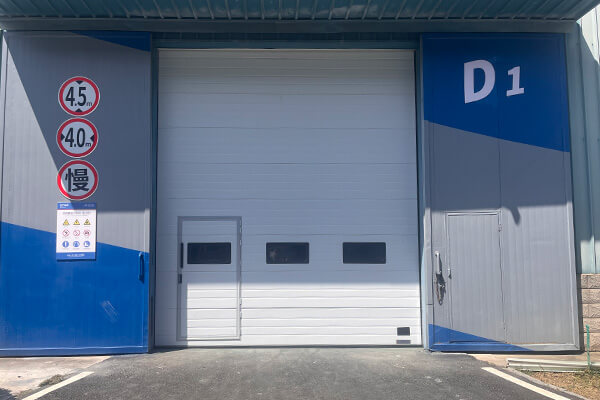
Industrial sectional doors in manufacturing facilities need to meet two important requirements: convenient pedestrian access and reliable structural performance under wind pressure. The industrial sectional door with wicket door provides a separate pedestrian entrance, while a safety interlock prevents the main door from operating when the wicket door is open.
For larger openings or areas exposed to strong winds, full-length rear reinforcement struts help improve door panel stiffness and reduce deflection. Combining a wicket door interlock with proper wind reinforcement creates a more practical solution for industrial facilities. This article explains how these configurations work and when they should be used together.
Why Do Industrial Sectional Doors Need a Wicket Door?
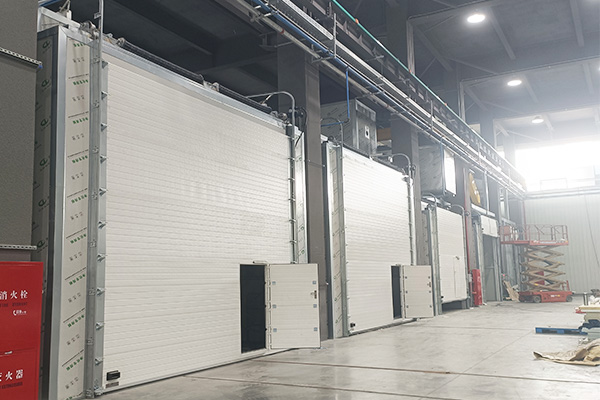
산업용 오버헤드 섹셔널 도어 are commonly installed at factory entrances where both pedestrians and vehicles need access. Adding a built-in wicket door provides a separate pedestrian entrance, allowing workers to enter and exit without opening the entire sectional door. This is particularly useful in manufacturing facilities where employees move frequently throughout the day, while vehicle and goods movements take place at specific times.
Separate Pedestrian Access from Vehicle Traffic
A wicket door creates an independent access point for personnel, while the main industrial sectional door is used for forklifts, pallet trucks, machinery and large goods. It should have its own reinforced frame, lock and handle, with additional reinforcement around the opening. When closed, the wicket door should sit flush with the main door panel to maintain a consistent door surface.
Reduce Unnecessary Door Operations
Opening the full-size industrial sectional door for every pedestrian movement increases operating cycles and exposes a much larger opening than necessary. With a wicket door, workers can pass through independently, while the main door only operates when vehicles or goods need to pass. This helps reduce unnecessary door operations, limit air exchange and maintain more stable indoor conditions, including temperature and cleanliness.
How Does a Industrial Sectional Door With Wicket DoorSafety Interlock Work?
Reinforced Wicket Door Frame and Independent Locking
The wicket door is built with an independent reinforced frame to maintain the strength of the surrounding sectional door panel. It features a separate lock and handle for convenient pedestrian access. Additional reinforcement around the opening helps support the modified panel structure. When closed, the wicket door sits flush with the main door surface, maintaining a consistent appearance and proper closure.
Electrical Interlock Between the Wicket Door and Main Door
A safety switch monitors whether the wicket door is fully closed. When someone opens the pedestrian door, the switch sends a status signal to the main door control system, immediately inhibiting normal door operation. If the wicket door is not fully closed, the main door remains disabled. Only after the wicket door is closed and its safety status is confirmed can the main door resume normal operation.
Industrial Door Control System
The interlock logic can be integrated into a dedicated industrial door controller, coordinating the wicket door safety signal with the main door operating commands. In configurations using an integrated interlock controller, such as the FROG PUPIL system, no additional external interlock module is required. This provides coordinated control while keeping the electrical configuration compact.
Can a Wicket Door and Wind Reinforcement Be Used Together?
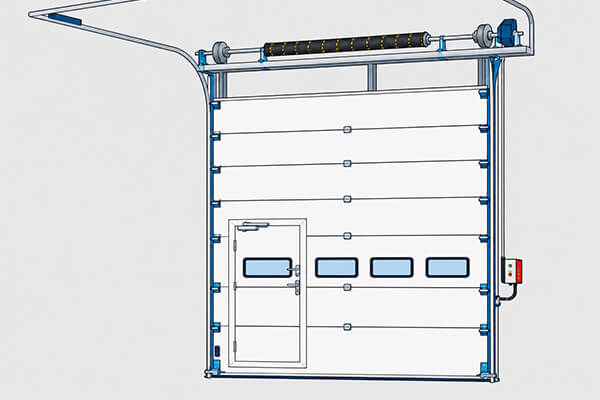
Yes. An industrial sectional door can combine a built-in wicket door with wind reinforcement, provided both features are planned as part of the same door structure. Since the wicket door creates an opening in the main panel, its surrounding frame requires independent reinforcement to maintain structural rigidity. Meanwhile, full-length rear reinforcement struts help improve door panel stiffness and reduce deflection under wind pressure.
The key is to coordinate the reinforcement layout with the wicket door frame before manufacturing. Reinforcement members must not interfere with the pedestrian door hinges, lock, handle or safety switch. If a reinforcement strut crosses the wicket door opening, its position and structural arrangement must be carefully redesigned rather than simply cut or relocated during installation.
The following table outlines the main design considerations:
| Component | Design Considerations | Main Purpose |
|---|---|---|
| Wicket door frame | Independent frame with reinforcement around the opening | Maintain local panel strength |
| Hinges and locking system | Keep sufficient clearance from reinforcement members | Ensure smooth pedestrian door operation |
| Rear reinforcement struts | Coordinate their position with the wicket door frame | Improve panel stiffness and wind resistance |
| Tracks and fixing brackets | Match the reinforced door structure and installation conditions | Support stable door operation |
This combined configuration is suitable for factories requiring both frequent pedestrian access and additional wind resistance. The final reinforcement design should be based on door dimensions, wind loads and the overall structural requirements.
Industrial Applications of Reinforced Sectional Doors with Wicket Doors
Reinforced industrial sectional doors are suitable for manufacturing facilities where structural stability, operational safety and specific environmental conditions must be considered. In applications such as machinery workshops, paint-baking booths and large factory entrances, door configurations should be selected according to opening dimensions, operating conditions and daily access requirements.
Reinforced Sectional Doors for Paint-Baking Booths
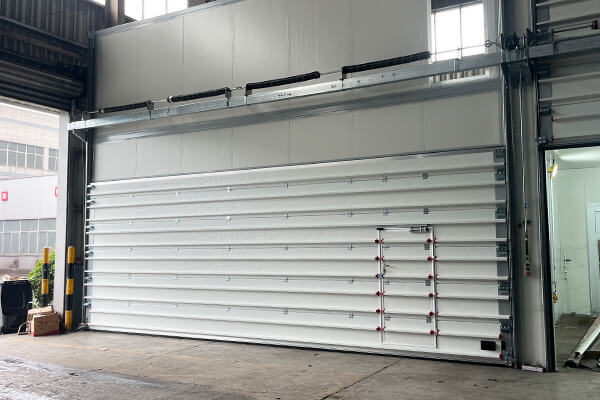
In a machinery manufacturing facility, a reinforced sectional door is used at a paint-baking booth where operating temperatures range from 50°C to 80°C. Under these conditions, the door must be designed to accommodate both the structural requirements of the opening and repeated exposure to elevated temperatures. Full-length rear reinforcement struts help improve door panel stiffness and reduce deflection, while the suitability of door panels, seals, hinges, springs and electrical components must be verified for the actual temperature and exposure duration.
Combining Structural Reinforcement with Pedestrian Access
For factories requiring frequent personnel access, a built-in wicket door can provide a separate pedestrian entrance without opening the entire sectional door. Its reinforced frame, hinges and locking system must be coordinated with the rear reinforcement struts to avoid structural interference. An electrical interlock can prevent the main door from operating while the wicket door is open, providing an additional layer of operational safety.
These configurations can be tailored to machinery plants, metalworking facilities and other industrial buildings with demanding operating conditions.
What Should You Check Before Ordering a Sectional Door?
Before ordering an industrial sectional door, several factors should be evaluated to ensure the door matches the building structure and operating conditions. Consider the following points:
- Door Opening Dimensions: Confirm the clear opening width and height, as well as the available headroom and side room for track installation.
- Pedestrian Access: Determine whether a built-in wicket door is needed and whether an electrical safety interlock should be included.
- Wind Load Requirements: Assess the local wind conditions and door opening size to determine whether full-length reinforcement struts or stronger tracks are required.
- 운영 환경: Identify exposure to moisture, dust, temperature changes or high temperatures, such as the 50–80°C conditions found in some paint-baking applications.
- Safety and Control: Confirm the required safety devices, operating methods and control system.
- Installation Conditions: Check the wall structure, fixing points and available installation space before finalising the door configuration.
Providing these details helps manufacturers recommend a suitable sectional door structure, reinforcement layout and control configuration for each project.
Frequently Asked Questions About Industrial Sectional Doors
1. Can a Sectional Door Have Both a Wicket Door and Reinforcement Struts?
Yes. An industrial sectional door can combine a built-in wicket door with rear reinforcement struts when both are included in the structural design. The wicket door frame, hinges and lock must be positioned so they do not conflict with the reinforcement layout. Final dimensions and fixing details should be confirmed before manufacturing.
2. How Does a Wicket Door Safety Interlock Work?
A wicket door safety interlock uses a safety switch to monitor whether the pedestrian door is fully closed. If the wicket door is open or not confirmed closed, the control system inhibits normal operation of the main sectional door. The main door can operate again only after the required closed status is restored.
3. Does Adding a Wicket Door Affect the Strength of a Sectional Door?
A wicket door creates an opening in the sectional door panel, so the surrounding area needs a properly reinforced frame. The effect on overall strength depends on the door design, opening size and reinforcement arrangement. The frame, hinges, lock and rear struts should be coordinated rather than designed separately.
4. When Should Reinforcement Struts Be Used on Sectional Doors?
Reinforcement struts may be needed for large sectional doors, wide openings or installations exposed to significant wind loads. Their size, spacing and fixing method should be selected according to the door dimensions, panel construction, local wind conditions, tracks and supporting structure. Adding more struts alone does not guarantee a specific wind rating.
5. What Should Be Considered When Installing a Sectional Door in a Paint-Baking Booth?
For a sectional door used at a paint-baking booth operating at 50–80°C, first confirm the temperature the door itself will experience and for how long. Check the temperature limits of panels, seals, hinges, springs, motor and control components. Reinforcement struts improve panel stiffness, but do not automatically make the door heat-resistant.
Conclusion: Choosing the Right Sectional Door Configuration
Choosing the right industrial sectional door requires balancing pedestrian safety and structural performance. A built-in wicket door with an electrical interlock provides convenient personnel access while preventing the main door from operating when the pedestrian door is open. Full-length reinforcement struts improve door panel stiffness and help resist wind pressure when properly designed. For projects requiring both features, their structural layout should be coordinated from the beginning. Contact SEPPES with your door opening dimensions, installation space and operating environment to receive a tailored sectional door solution.