
Contact us WhatsApp: 8618036828007


In today’s competitive industrial landscape, a manufacturing facility is more than just a production site—it is a visual extension of a company’s brand and commitment to quality. Modern factory owners now recognize that professional aesthetics and an optimized work environment are essential indicators of corporate strength and innovation. However, many high-end facilities, particularly in the environmental equipment sector, face a common architectural hurdle: traditional steel rolling shutters. While durable, these conventional doors often fall short in thermal insulation, block out natural light, it fails to match a premium brand image. To bridge this gap, upgrading to a high-performance sectional overhead doors with vision panels has become the gold standard. In this article, we explore how replacing old shutters with modern industrial sectional doors can transform your plant’s transparency, energy efficiency, and overall curb appeal.
Project Background: Upgrading the New Manufacturing Plant Doors
The customer is an environmental equipment manufacturer developing a new production facility with multiple workshop and warehouse entrances. During the planning stage, the company evaluated whether conventional steel rolling shutters could meet the functional and architectural requirements of the new plant.
Steel rolling shutters remain a practical option for many basic industrial openings. They are compact, relatively simple in structure, and suitable for areas where cost control and basic access are the main priorities. However, for this project, the customer also required better natural light, improved entrance visibility, stronger insulation, and a more coordinated factory appearance.
To meet these broader requirements, the original door concept was upgraded to custom industrial sectional overhead doors. Different configurations were then selected for the workshop and warehouse areas according to their daily use, visual requirements, and internal layout.
Limitations of Traditional Steel Rolling Shutters
Traditional steel rolling shutters are suitable for many basic industrial entrances, but they had several limitations for this new manufacturing plant:
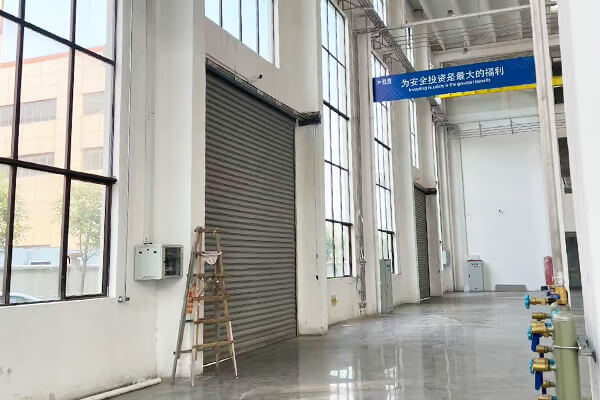
- Limited natural light: Solid steel slats block daylight and can make workshop entrances feel dark and enclosed.
- Traditional appearance: Corrugated slats and shutter boxes may not match the clean design of a modern factory.
- Limited insulation: Single-layer steel slats usually provide less insulation and sealing than insulated sectional doors.
- More operating noise: Metal slats may create more noise and vibration during opening and closing.
- Limited visibility: Solid shutters do not allow personnel or forklift operators to see through the doorway.
For this project, steel rolling shutters could not fully meet the customer’s requirements for daylight, visibility, insulation, smooth operation, and factory appearance.
The Customer’s Main Requirements
Before selecting the final door configuration, the customer identified four main objectives for the new manufacturing plant.
Improve natural daylight
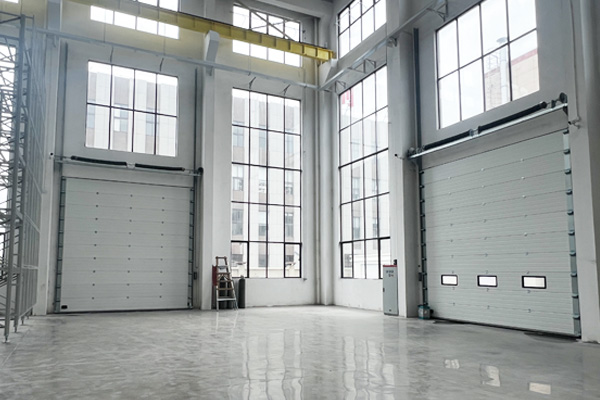
The workshop entrances needed to allow more daylight into the building when the doors were closed. Adding vision panels to the sectional overhead doors helped reduce the enclosed appearance of the large door openings and created a brighter entrance area during daytime operation.
Increase visibility around workshop entrances
The entrances were used by personnel, forklifts, and material-handling equipment. The customer therefore required better visual observation between indoor and outdoor areas. Correctly positioned vision panels help operators check approaching traffic and reduce blind spots around busy factory access points.
Create a consistent factory
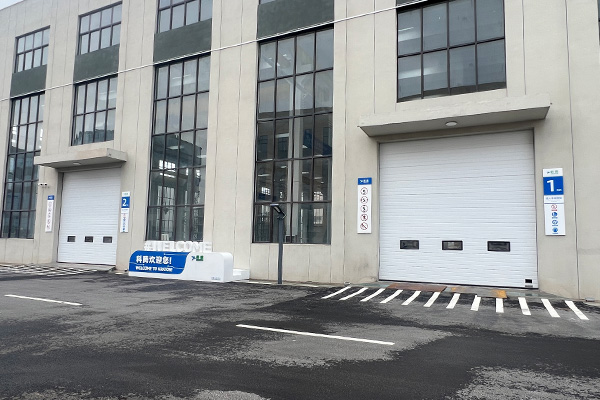
Because several industrial doors were installed along the same building elevation, the customer wanted the door panels, window positions, spacing, and colours to follow a coordinated design. A consistent vision panel layout created a clean visual line across the factory façade and helped the doors match the modern appearance of the new plant.
Select different door configurations for workshops and warehouses
Not every entrance had the same operational purpose. Most workshop sectional doors were equipped with vision panels to support daylight and visibility, while the warehouse doors used solid insulated panels without windows. This area-specific approach allowed the customer to balance appearance, observation, insulation, and practical warehouse requirements rather than applying one identical door design throughout the factory.
Why the Move from Rolling Shutters to Sectional Doors?
For years, steel rolling shutters were the default choice for industrial units. However, as modern architectural standards evolve, many facility managers are making the switch to industrial sectional doors. Here is why this upgrade is essential for high-end manufacturing plants:
Modern Aesthetic Upgrade
First impressions matter. Traditional rolling shutters, with their corrugated slats and bulky housing boxes, often give a factory a cluttered, “old-school” industrial look. In contrast, commercial sectional doors feature large, smooth-surfaced panels that create a clean, streamlined facade. For an environmental equipment company, this sleek design projects a message of precision, technology, and professional excellence, instantly elevating the building’s “curb appeal” to a premium level.
Superior Insulation & Energy Efficiency
For companies focused on environmental sustainability, energy waste is a significant concern. Traditional shutters are typically made of single-layer steel with numerous gaps between slats, allowing heat to escape. Insulated sectional doors are engineered with a sandwich structure—high-density polyurethane foam injected between steel skins. This design, combined with high-quality perimeter seals, provides exceptional thermal resistance. By maintaining a stable internal temperature, these doors reduce the load on HVAC systems, directly supporting the “green” mission of environmental firms.
Optimized Space & Structural Efficiency
The operational mechanics of factory sectional doors offer a distinct advantage in space management. While rolling shutters require a large circular drum above the lintel, sectional doors track vertically and then stow flat against the ceiling or follow the roof pitch. This “vertical lift” or “high-lift” design maximizes the usable overhead space, allowing for better clearance for cranes, forklifts, and lighting fixtures. The result is a more organized, spacious, and safer working environment.
Sectional Lifting Doors vs. Rolling Shutters: A Comparative Overview
| Feature | Traditional Steel Rolling Shutters | Industrial Sectional Overhead Doors |
| Aesthetics | Utilitarian, corrugated look; bulky drum box. | Sleek, flat panels; modern and professional finish. |
| Natural Light | None (solid metal slats block all light). | High (Integrated vision panels/windows). |
| Insulation | Poor (single-skin steel; frequent air gaps). | Excellent (Insulated sandwich panels with PU foam). |
| Space Usage | Requires large head-room for the roll. | Tracks along the ceiling; maximizes vertical space. |
| Operation | Noisy; high-friction rolling mechanism. | Smooth, quiet, and balanced track system. |
| Durability | Prone to denting and slat misalignment. | High-strength reinforced panels; easy to maintain. |
| Brand Image | Standard industrial warehouse. | High-tech, premium manufacturing facility. |
The Power of Sectional Overhead Door with Vision Panels: Transparency and Natural Light
Maximizing Natural Light and Energy Savings
One of the most immediate benefits of installing industrial sectional doors with windows is the dramatic increase in natural light. By allowing sunlight to penetrate deep into the workshop, these vision panels reduce the reliance on intensive artificial overhead lighting during daytime hours.
Enhancing Operational Safety
Safety is a top priority in any industrial setting. Sectional doors with vision panels provide critical visibility. At entrances used by employees, forklifts, and material-handling equipment, operators can check the area on the other side before opening the door. This helps reduce blind spots and supports safer movement around busy access points.
The height and position of the windows can be selected according to the door size, vehicle type, and required viewing level. This ensures better factory entrance visibility without affecting normal door operation.
A Consistent Factory Appearance
The vision panels were installed at a consistent height across the main workshop doors. This created a clean visual line along the building façade and gave the factory a more unified and professional appearance.
Matching window sizes, spacing, and positions helped the sectional doors blend with the modern design of the new plant. By combining daylight, visibility, and coordinated design. The sectional overhead door with vision panels became an important part of both the factory’s operation and its overall appearance.
Different Sectional Door Configurations for Workshops and Warehouses
Different areas of a manufacturing plant have different access and operational requirements. For this project, the environmental equipment plant sectional doors were configured according to the function of each entrance.
Vision Panel Doors for Workshop Entrances
Most workshop entrances were fitted with sectional overhead doors with vision panels.
- The windows allow more natural light into the entrance area and improve visibility between the inside and outside of the building.
- The vision panels also reduce the enclosed appearance of large industrial doors and support a brighter, more modern factory design.
- Their consistent position across multiple doors created a clean and coordinated appearance along the workshop façade.
Window-Free Sectional Doors for Warehouse Areas
The warehouse doors were supplied without vision panels based on the functional layout and configuration requirements of that area.
This project-specific arrangement shows that sectional door configurations do not need to be identical throughout the factory. Workshop entrances used vision panels to support daylight and visibility, while the warehouse area used solid door panels.
By selecting the right configuration for each location, the project achieved a practical balance between daily operation, factory appearance, and site-specific requirements.
Customized Sectional Doors with Windows for the Environmental Equipment Plant
The sectional overhead doors were customized for the workshop and warehouse entrances of the environmental equipment manufacturing plant. Each configuration was selected according to the doorway, installation space, daily traffic, and visual requirements of the new factory.
| Project Specification | Customized Door Solution |
|---|---|
| Industry | Environmental equipment manufacturing |
| Application | Workshop and warehouse entrances |
| Door Type | Industrial sectional overhead door |
| Door Panel | 40 mm thick double-skin insulated panel |
| Panel Core | Polyurethane foam filling |
| Panel Surface | Galvanized steel sheet with a coated finish |
| Vision Panels | Added to most workshop doors for daylight and visibility |
| Warehouse Doors | Solid sectional doors without vision panels |
| Operation | Electric opening and closing |
| Lifting System | Selected according to the available headroom and building structure |
| Sealing | Top, side, and bottom seals around the door opening |
| Safety Options | Safety bottom edge and anti-fall protection system |
| Panel Colour | Customized to match the factory façade |
| Door Size | Manufactured according to the actual opening dimensions |
How to Select Vision Panels for Industrial Sectional Doors
Determine the Main Purpose
Start by defining why the vision panels are required.
For workshop entrances, they may be used to bring more natural daylight into the building, support observation between indoor and outdoor areas, or improve visibility for vehicles and personnel. They can also form part of the factory façade design and make large industrial doors look less enclosed.
The main purpose will influence the size, number, and type of windows used in the sectional door.
Select the Window Position
The position of the vision panels should match the actual use of the entrance.
Important factors include the total door height, the type of vehicles passing through the opening, the normal sightline of personnel, and the layout of equipment near the doorway. For forklift entrances, the windows should provide a useful view of approaching traffic. For pedestrian observation, a lower viewing position may be more suitable.
The final layout should improve visibility without affecting the sectional door structure or lifting operation.
Keep Multiple Doors Visually Consistent
When several industrial sectional doors are installed on the same building, a consistent window layout creates a cleaner and more professional appearance.
Window size, installation height, spacing, panel colour, and door panel alignment should be coordinated across the factory façade. This helps the doors form a unified visual line and prevents each entrance from appearing as a separate design.
A consistent vision panel arrangement is particularly important for newly built factories where the doors are a visible part of the overall architectural design.
FAQs
How energy-efficient is a sectional overhead door with vision panels?
Sectional overhead doors with vision panels can be highly energy-efficient when specified with proper insulation like polyurethane insulation and high r-value cores. In both industrial and commercial applications, an insulated sectional garage door reduces heat transfer between interior and exterior environments, improving HVAC performance in loading docks, service facilities, and garages. Glazing options for vision panels can be double-pane or thermally broken to further minimize air and water infiltration and provide excellent insulation while maintaining visibility.
What are aluminum full-view doors and how do they compare to sectional overhead doors with vision panels?
Aluminum full-view doors are a type of commercial overhead door constructed with aluminum frames and large sections of glazing to provide maximum visibility and natural light. Compared with sectional steel doors with vision panels, aluminum full-view doors offer a lighter-weight, customizable design that is ideal for storefronts and interior and exterior applications where aesthetics and daylighting matter. Sectional overhead doors with vision panels, however, can provide heavier-duty options and higher security or insulation when built with steel and polyurethane insulation.
Can a sectional overhead door with vision panels be used on a residential garage?
Yes, sectional garage doors with vision panels are suitable for residential garage applications as well as commercial garage doors. Homeowners often choose vision panels for natural light and to see through to driveways. Make sure the door system is sized correctly for width and height, and that glazing is appropriate for privacy and insulation. For residential use, standard door hardware and torsion spring systems are commonly employed for smooth operation and long-lasting performance.
How customizable is a sectional overhead door with vision panels?
Sectional overhead door systems are highly customizable. You can choose panel materials (steel, aluminum), glazing types (clear, frosted, insulated), insulation (polyurethane insulation for excellent insulation and higher r-value), hardware finishes, and control options. Customization extends to dimensions—width and height—to fit unusual openings, and to add features like vision panels at specific panel heights, safety sensors, and enhanced sealing to reduce air and water infiltration.
What should I consider when specifying commercial sectional doors for an industrial facility?
When specifying commercial sectional doors for industrial and commercial applications consider duty cycle (frequency of use), required insulation (r-value and polyurethane insulation), glazing needs (glazing for visibility and safety), and the loading systems they serve such as loading docks or loading bays. Also evaluate hinge and torsion spring durability, compatibility with dock equipment, available replacement parts, and whether aluminum full-view doors or sectional steel doors better meet your security and thermal performance requirements.
How do heavy-duty components like hinges and torsion springs affect the lifespan of sectional overhead doors?
Heavy-duty hinges, rollers, and torsion springs are critical to the long-lasting, smooth operation of sectional overhead doors. Industrial and commercial applications demand robust hardware rated for high cycle counts; better-quality torsion systems provide balanced operation and reduce wear on motors and tracks. Regular maintenance and access to replacement parts ensure durability and minimize downtime at service facilities and commercial garage doors.